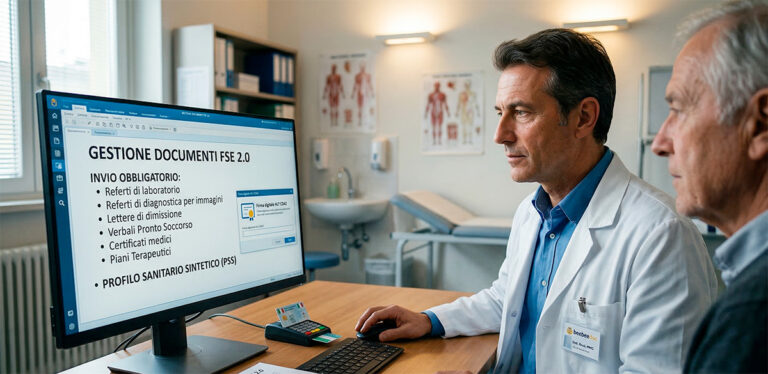



FSE 2.0: who has to send documents, and who can no longer wait
The Electronic Health Record 2.0 is not an option. It is a legal obligation for anyone producing health documents in Italy - and the deadline is set at 31 March 2026.
But the question we are asked most often is simple: does it affect me too?
The answer, in the vast majority of cases, is yes.
Who is required
Looking for practice management software already accredited for FSE 2.0?
BeebeeDoc is accredited by Italy's Ministry of Health to send documents to FSE 2.0 automatically. Free 15-day trial, no credit card required.
The rules apply to all parties that provide healthcare services and produce clinical documentation. In practice:
General practitioners and freely chosen paediatricians - fall under the obligation for all documents they produce in the course of their work.
Specialist doctors, both those working within facilities and self-employed professionals with a private practice - every signed medical report must be sent to the FSE within 5 days of the service being delivered.
Multi-specialty clinics and private healthcare facilities - the obligation applies to all documents produced: medical reports, discharge letters, prescriptions, certificates.
Clinical analysis laboratories - laboratory tests are explicitly included in the list of documents to be transmitted.
Public hospitals and accredited private facilities - for them the work to comply was already under way, but Phase 2 of FSE 2.0 imposes updated standards and full interoperability.
Who is not yet required — but soon will be
The only situations in which the obligation is temporarily suspended concern regions whose regional gateway is not yet operational. In these cases, healthcare facilities cannot be penalised for failing to send data: the responsibility lies with the region, not with the professional. But this is a temporary window: as soon as the region catches up, the obligation applies immediately.
What happens to those who do not comply
The penalties laid down by the legislation strike on two fronts. The first is financial: failure to comply can lead to the reduction or suspension of reimbursements for services provided to the SSN (Italy's National Health Service). The second is reputational: failure to transmit documents to the FSE is verifiable and traceable.
The good news is that complying is simpler than it looks — provided you have the right software and an active digital signature.
The starting point: the personal digital signature
One thing many people underestimate is that the signature on FSE documents must be that of the individual reporting doctor, not of the facility. This means that every professional must have their own digital signature device (USB token or smart card) before they can send any document.
If you are not yet compliant on this point, it is the first thing to fix.
Start your free trial today
Want to try BeebeeBoard? The trial is free. No credit card required, and for 15 days you can explore everything BeebeeDoc can do.