


Which documents must be sent to FSE 2.0: the complete list
One of the most practical — and most misunderstood — parts of adapting to FSE 2.0 concerns documents. Not everything a doctor produces has to go to the record, but far more does than people expect.
The general principle
Looking for practice management software already accredited for FSE 2.0?
BeebeeDoc is accredited by Italy's Ministry of Health to send documents to FSE 2.0 automatically. Free 15-day trial, no credit card required.
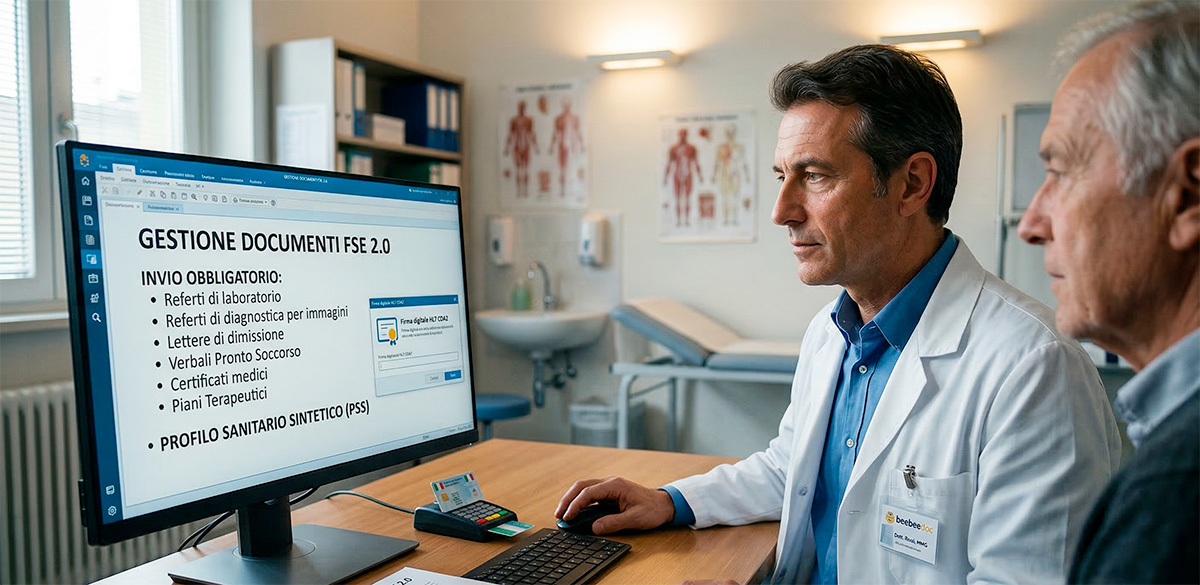
The rules state that every clinical document produced after a service has been delivered must be sent to the patient's FSE within 5 days of the date it was produced. The document has to meet the national standard HL7 CDA2 (Clinical Document Architecture, version 2) and must be digitally signed by the professional who wrote it.
The document types covered
Laboratory test reports — among the first documents brought into the FSE obligation. Every blood, urine, microbiology or other test result has to be sent.
Diagnostic imaging reports — X-rays, ultrasound scans, MRI, CT. The written report must be sent; the images follow specific rules that vary by region.
Emergency department records — every attendance at an emergency department generates a document that has to be sent, whatever the outcome: discharge, admission or transfer.
Hospital discharge letters — the discharge letter, or epicrisis, falls squarely within the obligation.
Outpatient specialist reports — cardiology, dermatology, orthopaedic, neurology and every other specialist consultation produces documents that must be sent.
Pharmaceutical and specialist prescriptions — paperless prescriptions, in circulation for years already, are folded into FSE 2.0 in a more structured way.
Medical certificates — sickness certificates, sports fitness certificates, exemption certificates and other clinical certificates all fall within the obligation.
Treatment plans — documents that set out a course of care over time must be recorded in the patient's file.
Patient Summary (PSS) — the document usually written by the general practitioner summarising the patient's clinical history. It is one of the pillars of FSE 2.0.
The format: why HL7 CDA2 matters
None of these documents can be sent in just any format. The rules require the HL7 CDA2 standard, which defines a precise XML structure for each document type. This is what makes systems interoperable: a report produced in Sicily has to be readable and interpretable by a system in Valle d'Aosta.
In practice this means the practice management software has to generate documents that meet the standard automatically. A Word file or an unstructured PDF is not enough.
Who signs what
Another critical point is the distinction between who produces a document and who signs it. The digital signature must belong to the reporting doctor, not to the organisation they work for. If five specialists work in a multi-specialty clinic, each of them needs their own personal digital signature and signs the documents that fall to them.
This is where many organisations are finding themselves unprepared: checking that every professional holds a digital signature is one of the first concrete items to put on the agenda.
Start your free trial today
Want to try BeebeeBoard? The trial is free. No credit card required, and for 15 days you can explore everything BeebeeDoc can do.