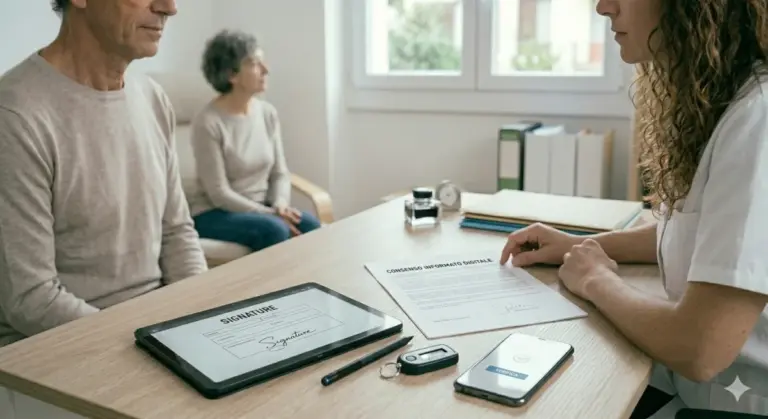

The graphometric signature is a biometric technology that authenticates digital documents by capturing your signature on a tablet. It is a legal, secure and certified way to sign medical consents, clinical records and administrative documents.
What the Digital Graphometric Signature Is
The graphometric signature is an advanced biometric authentication system. When you sign on a tablet with a stylus, the device captures behavioural data from your signature, not just the image.
Unlike a simple scan, the technology records:
- Signing speed: how many millimetres per second you draw.
- Stylus pressure: the force applied while signing.
- Tilt and angle: the angle of the stylus relative to the tablet.
- Rhythm and acceleration: the natural movement patterns of the hand.
- Sampling rate: the time accuracy of the biometric data.
These parameters create a biometric profile that is almost impossible to forge. Every signature is as unique as a fingerprint.
Graphometric Signature as an Advanced Electronic Signature (FEA)
In Italy, the graphometric signature falls into the FEA (advanced electronic signature) category. This means it has full legal value under the Digital Administration Code (CAD).
The eIDAS regulation (EU Regulation 910/2014) recognises the graphometric signature as valid throughout Europe. Before courts, notaries and public authorities it has the same validity as a handwritten signature on paper.
The DPCM of 22 February 2013 (Italy’s Prime Ministerial Decree) sets the technical requirements for secure digital signatures. The graphometric signature meets them because it uses certified cryptographic algorithms, a notarial timestamp, full recording of the biometric data and complete traceability of the act.
AgID (Agenzia per l’Italia Digitale) has issued guidelines confirming that the graphometric signature meets national security criteria.
In healthcare, this form of signature protects sensitive data in line with GDPR. The biometrics are recorded in encrypted form, never visible in clear text.
Do you want to get rid of paper in your medical practice?
BeebeeDoc is the cloud medical practice management software that combines graphometric signing on a tablet with OTP signing to digitise consents and documents. Free 15-day trial, no card required.
Practical Applications in the Medical Field
Medical practices and healthcare facilities use the graphometric signature to:
- Digital informed consent: patients sign treatment agreements on a tablet in real time.
- Electronic clinical records: doctors authenticate visits, prescriptions and diagnoses.
- Medical certificates: official documents signed with immediate legal value.
- Treatment authorisations: biometric signature for specific procedures.
- Administrative documentation: invoices, statements, contract deeds.
In dental practices, the graphometric signature has become standard for implant and prosthetic consents.
How the Graphometric Signature Works Technically
The process takes a few seconds. The patient gets the document on a tablet and signs with a stylus, naturally.
The software captures the X and Y coordinates of the stylus tip in real time. It records the pressure in pascals applied at each point. It measures the tilt angle of the pen (the Z axis). It captures a precise timestamp for every microscopic movement.
The biometric data is encrypted with AES-256 algorithms. A signature authority server adds a notarial timestamp compliant with RFC 3161. The document receives a legally valid X.509 digital certificate.
The signature can be verified immediately. Anyone can check its authenticity without special software, by consulting certified public registers.
OTP Signature: A Valid Alternative for Remote Patients
Not all patients have physical access to a tablet. For remote appointments and home care, there is OTP signing (One-Time Password).
With the OTP signature, the patient receives a one-time code by SMS. They enter the code in the app to confirm their identity and sign the document digitally.
OTP signing is recognised as an FEA if it is carried out to ETSI standards. It has the same legal value as the graphometric signature. It is ideal for elderly patients, people with motor disabilities, or anyone who cannot come to the practice.
BeebeeDoc includes both methods in the same practice management software. You can switch from graphometric signing in the practice to OTP signing for remote patients.
Regulatory Compliance and Data Security
The graphometric signature ensures full GDPR compliance. Biometric data is a category of sensitive personal data (Article 9 GDPR).
Their processing requires:
- Explicit patient consent for the collection of biometric data.
- End-to-end encryption during transmission and storage.
- Access limited to authorised staff with defined roles.
- Full audit trail of who has access to the data.
- Backups on servers certified to ISO 27001.
No biometric data travels in clear text. Certified software keeps the data separate from other databases.
The Digital Administration Code (CAD) requires the qualified graphometric signature to be performed with an HSM (Hardware Security Module). This makes any alteration or theft of cryptographic keys impossible.
Benefits of the Graphometric Signature in 2026
No more paper. Digital practices cut the cost of physical storage and document searches.
Operational speed. Consent forms signed in 15 seconds instead of 5 minutes on paper.
Perfect traceability. Every signature is recorded precisely, with date, time and identity. Documents cannot be lost.
Biometric security. No password or key needed. The signature itself is the authentication.
Immediate legal value. No notary referral or outside authority. The document is valid from the moment of signing.
European compatibility. The signature is valid in all 27 EU states. Useful for practices with international patients.
Automatic regulatory compliance. No risk of procedural irregularities. The document is generated already compliant with the CAD and eIDAS.
Practical Implementation with BeebeeDoc
BeebeeDoc is cloud practice management software with the graphometric signature built in natively. No external software is needed.
The workflow is simple:
- The doctor prepares the document (consent, prescription, certificate) in the system.
- Hand the tablet to the patient with the form ready to sign.
- The patient signs naturally with a stylus provided by the practice.
- The system captures biometric data, encrypts it, archives it and generates a signed PDF.
- The document is immediately available in the digital clinical record.
No complex training is required. The interface is as intuitive as signing on paper. Patients show no resistance.
For remote patients, BeebeeDoc automatically switches on OTP signing. Same document, same legal value, different method.
Final Considerations
The graphometric signature is a mature, legal, certified solution for Italian doctors in 2026. It solves the paper documentation problem for good.
The investment is moderate. It does not require complex IT infrastructure. ROI is fast thanks to lower costs for paper, archiving and document handling.
Patients appreciate it. The perception is modern, digital, reliable. The practice gains a reputation for technical excellence.
Compliance with GDPR, CAD and eIDAS is automatic. No legal risk. The signature is certified by public authorities.
If you are considering going digital, the graphometric signature with BeebeeDoc is an ideal starting point. Simple, secure, legal.