


The handwritten signature is an endorsement written, dated and signed entirely in the signatory's own hand, with no need for witnesses or other legal formalities.
What a handwritten signature is: legal definition
The handwritten signature is governed by article 2702 of the Italian Civil Code. It is the simplest form of signing by hand. It requires no notarisation or certification.
Under the Italian Civil Code, a handwritten signature must be:
- Written entirely by hand by the signatory;
- Contain the date of the document;
- Be signed in the signatory's own hand;
- Refer to a document that is also handwritten.
The handwritten signature is fully valid in law in many areas. However, the law excludes certain deeds from handwritten form.
Essential features and requirements
The handwritten signature has very specific characteristics. It must be autograph, that is, written personally by the signatory. It cannot be printed, typed or produced by someone else.
The essential requirements are:
- Autography: the signatory writes in their own hand;
- Dating: the document must bear the date;
- Subscription: signature placed at the foot of the document;
- Capacity: the signatory must have legal capacity to act.
A handwritten signature does not need authentication or verification at public offices. That makes it practical and immediate for common private documents.
From handwritten signature to digital signature in one click
BeebeeDoc is the cloud medical practice management software that replaces the handwritten signature with graphometric and OTP signatures, with full legal force. Free 15-day trial, no card required.
Difference between a handwritten signature and an autograph signature
The handwritten signature and the autograph signature are often confused, but they are not the same. An autograph signature is any signature written by hand. It can appear on typed documents.
The main difference concerns the document signed. The handwritten signature requires the whole document to be written by hand. The autograph signature can also be applied to typed or printed documents.
- Handwritten signature: document + signature, both handwritten;
- Handwritten signature: signing by hand on any document medium;
- The handwritten signature is an essential requirement for certain deeds;
- The autograph signature is the ordinary form in many contexts.
Digital signature: what changes compared with the handwritten signature
The digital signature is a complete technological step forward from the handwritten signature. It is governed by the eIDAS Regulation (Electronic Identification and Trust Services) and by the Italian Digital Administration Code.
The digital signature uses advanced cryptographic technologies. It guarantees the authenticity, integrity and non-repudiation of the document.
- The digital signature requires a qualified digital certificate;
- It applies to documents in electronic format;
- It has greater legal validity than a handwritten signature;
- It prevents later changes to the document;
- It is recognised internationally (eIDAS).
The digital signature does not completely replace the handwritten signature in private settings. It remains essential for public and administrative documents.
Graphometric signature: the modern solution
The graphometric signature is a form of digital biometric signature. It captures the dynamics of signing through a touchscreen or specific devices.
Unlike a handwritten signature, the graphometric signature records the pressure applied while signing, the speed of the stroke, the angle of the pen and the overall movement of the hand.
- The graphometric signature has the same legal value as a digital signature;
- It is governed by the eIDAS Regulation;
- It prevents forgery better than the handwritten signature;
- It is ideal for medical and contractual documents;
- Works on tablets and touch devices.
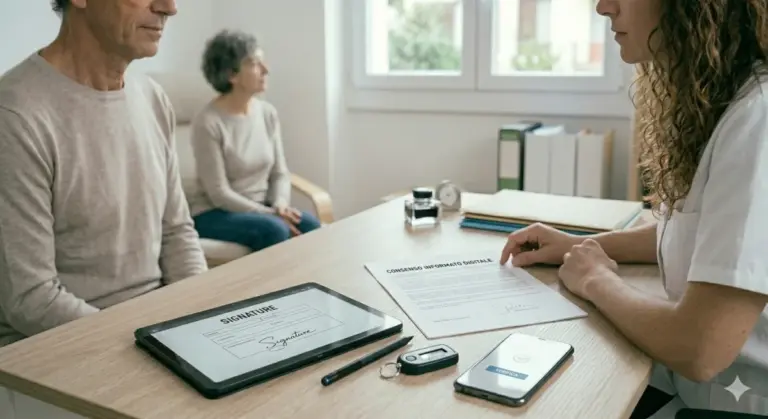
BeebeeDoc uses the graphometric signature to replace paper in medical practices. Patients sign directly on a tablet with full legal validity.
OTP signature: two-factor authentication
OTP stands for One-Time Password. It is a temporary, single-use code generated to authenticate the signing of digital documents.
The OTP signature does not replace the handwritten signature in the strict sense. It is, however, a modern and secure method of authentication.
- The OTP is sent by SMS or email to the signatory;
- It is valid for a few minutes;
- It serves to confirm the signatory's identity;
- It is often combined with a graphometric signature;
- It protects against unauthorised access.
Medical practices use the OTP signature alongside the graphometric signature for maximum security. This combination completely replaces the handwritten signature on paper.
Handwritten signature in healthcare: when it is enough
In healthcare, the handwritten signature is still used for many traditional documents. It remains valid for traditional clinical records, handwritten prescriptions, reports signed by hand and paper informed consent forms.
A handwritten signature is enough when the document is on paper and kept in physical archives. The doctor signs in person with a pen.
- Diagnosis and prognosis documents on paper;
- Sickness certificates (for some uses);
- Hospital discharge letters;
- Clinical notes in traditional records;
- Paper medical prescriptions.
However, the move to digital calls for solutions more reliable than the handwritten signature. The graphometric signature offers greater security and traceability.
When a handwritten signature is not enough
There are many healthcare settings where the handwritten signature is not adequate. Digitising processes calls for more sophisticated forms of signature.
- Documents in digital format require a digital or graphometric signature;
- Digital informed consents require a biometric signature;
- Electronic prescriptions require a qualified signature;
- Electronic medical reports do not accept a scanned handwritten signature;
- Electronic clinical records require a certified signature.
GDPR stresses the security and traceability of medical data. A scanned handwritten signature does not meet these requirements.
Medical practices working with digital documents must adopt either a graphometric signature or a digital signature. BeebeeDoc provides both, built into the management software.
Moving to the graphometric signature: the next step
The move from the handwritten signature to the graphometric signature is natural and gradual. Medical practices adopt the digital signature step by step to work more efficiently.
The advantages of the graphometric signature are clear: documents kept digitally without deterioration, complete traceability of every signature applied, impossibility of forgery thanks to biometric technology, and compliance with eIDAS and digital regulations.
- The graphometric signature on a tablet is intuitive for patients and doctors;
- It does not require complex certificates like a digital signature;
- It has the same legal value as a digital signature;
- It cuts signing and archiving times;
- It allows secure electronic transmission of documents.
BeebeeDoc: graphometric and OTP signing for medical practices
BeebeeDoc is a cloud medical practice management software that combines graphometric and OTP signatures. It lets doctors give up paper entirely.
The BeebeeDoc system offers an electronic clinical record with graphometric signature, digital informed consent forms signed by the patients themselves, electronic prescriptions with biometric signature and digital medical reports that can be traced and consulted remotely.
- Patients sign on a tablet at the practice;
- The graphometric signature has full legal value;
- OTP adds an extra layer of security;
- Data stays protected in a GDPR-compliant cloud;
- Simple access from desktop, tablet or smartphone.
BeebeeDoc makes the move from paper to digital simpler. No compromise on security or legal compliance.
Conclusion: handwritten signature, digital signature and the future
The handwritten signature remains legally valid, but it is not the future of digital healthcare. It is a tool of the past, limited by paper.
The graphometric signature and OTP are the natural next step. They offer greater security, traceability and efficiency than the handwritten signature.
Medical practices that adopt BeebeeDoc do not just modernise their processes. They give patients transparency and protection under the GDPR and the Digital Administration Code (CAD).
Moving from the handwritten signature to the digital signature is an informed choice towards greater efficiency and security.
Start your free trial today
Want to try BeebeeBoard? The trial is free. No credit card required, and for 15 days you can explore everything BeebeeDoc can do.