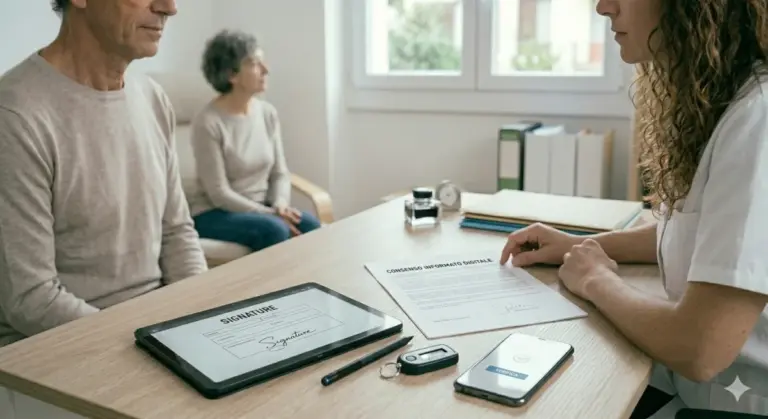



Remote patient signature: clinical documentation without geographical limits
Remote patient signing has become essential in the era of telemedicine and digital health. Whether a patient lives in Milan or in a small province, or receives an online consultation, they must be able to sign informed consents, authorisations and clinical documents with the same legal validity as a paper signature. Remote signing is not just a technological convenience: it is a legal requirement recognised by European rules such as eIDAS (EU Regulation 910/2014) and by Italian law on the Digital Administration Code (CAD).
In this article we will look at what the remote signature is, its legal types (FES, FEA, FEQ), how BeebeeDoc integrates it into the clinical record for collecting informed consent, authorisations and digital documentation, ensuring GDPR compliance and absolute legal validity.
What remote signing is and why it matters for telemedicine
The remote signature is a cryptographic mechanism that lets a person sign a digital document from anywhere and at any time, without having to be physically present at the medical practice. Unlike a traditional paper signature, the remote signature creates a unique, irrevocable link between the signatory, the document and the timestamp, guaranteeing authenticity, integrity and non-repudiation.
For patients receiving telemedicine, home visits or remote consultations, the remote signature solves a long-standing problem: how do you collect legally valid informed consent without meeting in person? With the remote signature, the patient can authorise a treatment directly from their smartphone during a video call, the doctor immediately receives the signed and certified document, and everything is tracked in the clinical file with full GDPR compliance.
The legal framework for remote signatures in Italy and Europe
Remote signing is governed by two fundamental legal pillars. EU Regulation 910/2014 (eIDAS) establishes that a qualified digital signature has the same legal value as a handwritten signature in every Member State of the European Union. In Italy, the Digital Administration Code (CAD) (Legislative Decree 82/2005) transposes this directive and requires digital health services to use qualified signatures for critical documents such as medical reports, prescriptions and informed consents.
The Agenzia per l'Italia Digitale (AGID) oversees the technical adequacy of signature certifiers and publishes specific guidelines for healthcare facilities. The Ministry of Health has since specified that for clinical record documents, including informed consent in the Electronic Health Record (FSE 2.0), the use of a qualified digital signature (FEQ) is mandatory.
Types of digital signature: which one to choose for your practice?
There are three levels of digital signature, each with a different degree of legal validity and security. Understanding the differences is essential in choosing the right solution for your medical practice.
Simple Electronic Signature (FES): is the most basic form of digital signature. It identifies the signatory but does not guarantee the authenticity of the document or that the signatory intended to authorise the content. Its evidential value is weak and it is not enough for critical medical documents.
Advanced Electronic Signature (FEA): uses cryptographic techniques to guarantee the authenticity and integrity of the document. The signatory is uniquely identified and the document cannot be altered without invalidating the signature. However, it is not equivalent to a handwritten signature under Italian law and it is not enough for official medical reports or consent forms.
Qualified Digital Signature (FEQ): it is the highest level of legal validity. The FEQ is issued by a Certifier accredited with AGID, uses strong encryption (typically 4096-bit RSA) and has exactly the same legal value as a handwritten signature. It is the only type of signature accepted for medical reports, prescriptions and informed consent in Italian digital healthcare.
Legally valid remote signature for your clinical documentation
BeebeeDoc integrates qualified digital signature directly into the cloud clinical record to collect informed consent, authorisations and medical reports with full legal validity. Free 15-day trial, no card required.
How to collect digital informed consent with remote signing
Informed consent is one of the critical documents in medical practice. Traditionally, the doctor prints the form, the patient signs it with a pen, and the paper document is filed in a folder. With remote signing built into BeebeeDoc, the process is fully digital and more traceable.
The flow is simple: the doctor generates the consent form directly in the clinical record, the system automatically sends a link to the patient by email or SMS, the patient receives the form on their device (smartphone, tablet or computer), reads the consent and signs electronically using a qualified signature, the signed document returns automatically to the clinical file with a timestamp and certificate of authenticity, and a copy stays available to the patient for their own records.
This flow ensures that consent is legally valid, fully tracked and stored in line with the GDPR with end-to-end encryption.
Remote authorisations and documentation: simplifying admin work
Besides informed consent, many medical practices need other signatures: authorisations to process data, authorisations for family members, confidentiality forms, care plans agreed with the patient. With remote signing, all this paperwork can be collected without paper and without inconvenience for the patient.
The benefits of fully digital documentation include: a sharp reduction in the paper used in the practice, faster document collection (from days to minutes), full traceability of who signed what and when, automatic GDPR compliance, secure cloud storage with no risk of loss, and immediate access to the documents from the clinical file when needed.
Remote patient signing and GDPR compliance
Remote signing is not only a legal tool, it is also a pillar of clinical data protection under the GDPR. When a patient signs a consent for a treatment, the system must record not only the consent itself but also the proof that the patient understood what they were authorising. With the qualified signature, the GDPR is satisfied because:
The signature proves authenticity and non-repudiation: the patient cannot later deny having signed. The certified timestamp proves exactly when consent was given. The clinical file records which version of the form was signed, ensuring historical traceability. End-to-end encryption protects sensitive data during transmission and archiving. The complete audit trail guarantees accountability and regulatory compliance that can be verified in the event of an inspection.
Integration with the Electronic Health Record (FSE 2.0)
The Ministry of Health made it compulsory from 2023 to upload informed consents into the Electronic Health Record version 2.0. BeebeeDoc is FSE 2.0 accredited and integrates remote signing so that signed consents are automatically transferred to the patient's file on the national portal, making them immediately visible to the patient and to all the authorised staff treating them.
This integration has removed duplicate registers: consent lives in one place, it can be reached by doctors in different facilities if the patient authorises it, the patient has full control over who accesses their consents, and compliance with Sistema Tessera Sanitaria is guaranteed automatically.
Technical security of the remote signature: how BeebeeDoc implements it
The security of the remote signature depends on two factors: unique identification of the signatory and cryptographic protection of the document. BeebeeDoc uses signature certifiers accredited with AGID, ensuring that every signature can be verified with the central authorities. The technical process includes: two-factor authentication for the signatory, RSA 4096-bit encryption for generating the signature, timestamping from an authorised server to certify the exact time of signing, storage on ISO 27001 certified servers with redundant backup and AES-256 encryption.
When a document is signed in BeebeeDoc, the system generates a "digital envelope" that contains the document, the cryptographic signature, the signatory's certificate and the timestamp. This envelope is immutable and verifiable: if even a single character of the document is changed, the signature becomes invalid.
Practical implementation of remote patient signing in the practice
Introducing the remote signature does not require major technology investment. The main steps are: setting up the BeebeeDoc platform with your standard consent and authorisation forms, training medical and administrative staff on how to send documents to patients for signature, telling patients that from now on they will receive documents to sign digitally, testing with a small group of patients before the full rollout.
The BeebeeDoc support team helps at every stage, from initial setup to later fine-tuning. Most practices are up and running within 1-2 weeks.
FAQ: frequently asked questions on remote patient signatures
Does a consent form signed with a remote signature have the same legal value as one signed in person? Yes, absolutely. If it is a qualified digital signature (FEQ), it has exactly the same legal value under GDPR, eIDAS and the Italian Digital Administration Code.
What if the patient has no access to a computer or smartphone? BeebeeDoc lets the doctor print a QR-coded form that the patient can sign physically at the practice; the QR code is then scanned to record the signature in the app. That said, most patients today have access to at least one mobile device.
How do I make sure the patient has really read the consent form before signing? BeebeeDoc records the patient's "gestures" while reading: time spent reading, scrolling, clicks on specific sections. This data supports the demonstration that consent was informed, which is relevant to medical liability.
Can BeebeeDoc be integrated with the telemedicine platforms we already use? Yes. BeebeeDoc offers APIs for integration with video platforms, patient management systems and patient portals. Consent forms can be sent to the patient automatically during a video consultation.
Conclusion: the remote signature as the standard of modern practice
Remote patient signing is not futuristic technology; it is a practical, legally recognised standard that modern medical practices must adopt. With BeebeeDoc, collecting informed consent, authorisations and other documentation becomes a simple, tracked process that complies with every regulation—all without paper, without delay, and with absolute legal validity.
If you run telemedicine or home visits, or simply want to modernise your practice's administration, try BeebeeDoc free for 15 days and see how remote signing can simplify your work while keeping you compliant and secure.
Start your free trial today
Want to try BeebeeBoard? The trial is free. No credit card required, and for 15 days you can explore everything BeebeeDoc can do.