


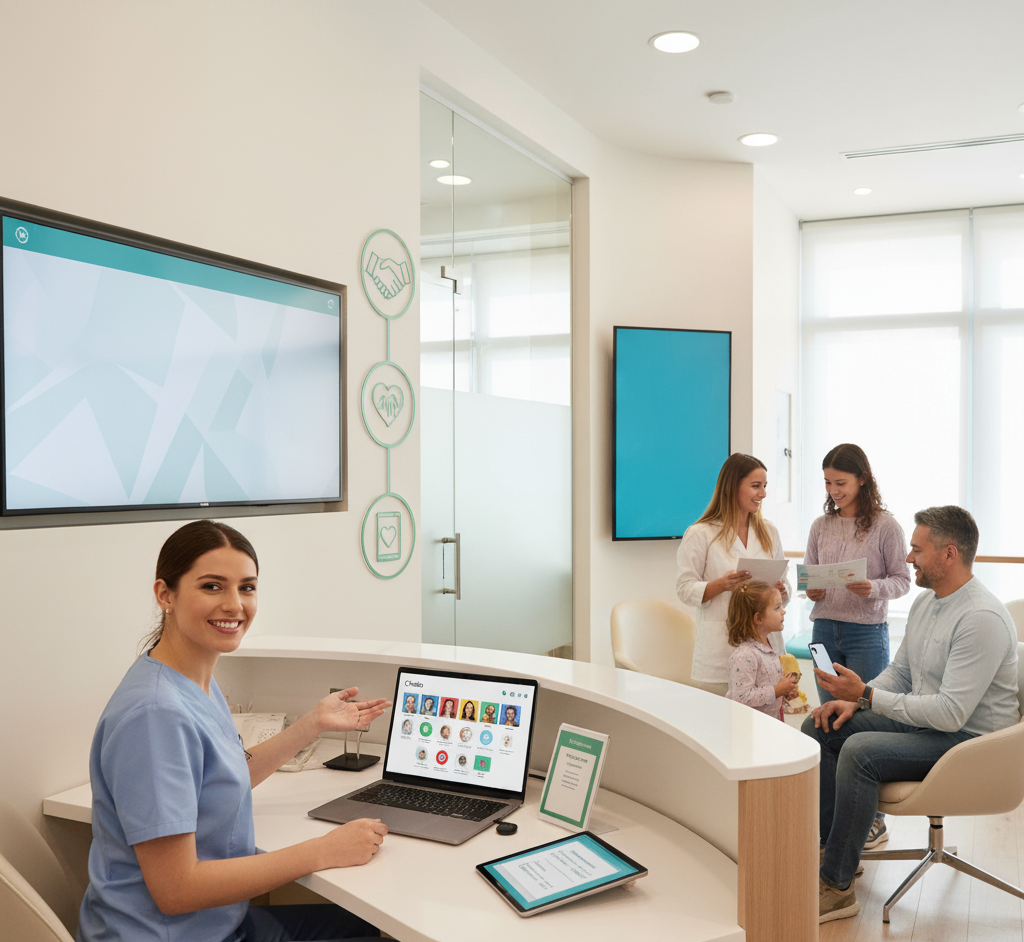
Customer service in a clinic is not a secondary matter: it is the competitive differentiator that decides whether patients come back or choose a competitor. A medical practice with excellent clinical results but poor service loses patients. Conversely, an average practice with excellent service generates loyalty and positive word of mouth. Discover the strategies for excelling at clinic customer service and how BeebeeDoc's technology helps you.
Why clinic customer service determines retention
Patients judge a medical practice on two dimensions: clinical competence and quality of service. Both count. A patient who gets the right diagnosis but waits 2 hours, has to call back 5 times for the results, and is treated rudely does not come back.
Statistics show that 70% of patients who leave a practice do so not because of clinical problems, but because of poor service. Waiting times, difficulty getting in touch with the practice, lack of proactive communication.
What is more, patients who are unhappy with the service talk about it: every dissatisfied patient tells 5-10 people about their bad experience. Satisfied patients, by contrast, rarely mention it. This creates a dangerous asymmetry for your reputation.
Element 1: Honesty and transparency in communication
Honesty is the foundation of trust. Patients prefer to know the truth, even when it is hard, rather than find out they have been misled. If a treatment has risks, communicate the risks. If the situation is serious, do not play it down.
Be transparent about the non-clinical side too: costs, waiting times, alternative treatment options. A patient who understands the care pathway follows it better and is more satisfied.
Practical step: instead of saying "the results arrive tomorrow", say "the test results will arrive by Wednesday 9 April. I will contact you by SMS as soon as they are available, so you do not have to call."
Element 2: Empathy and active listening
Empathy means understanding the patient's emotional state, not just their medical problem. A patient coming for the first time is anxious. A patient with a serious diagnosis is frightened.
Active listening means asking questions, waiting for the answers, making eye contact, taking the time needed. The patient must feel that the doctor is really listening, not looking at the computer or the clock.
Reception staff must show empathy too. A rude receptionist who treats patients as numbers creates a bad first impression, whatever the clinical competence.
Practical step: during the appointment, put your phone on silent (not on vibrate), make eye contact, ask "how are you feeling today?" and listen to the whole answer before moving on to clinical questions.
Element 3: Smooth multi-channel communication
Modern patients want to communicate in the ways they prefer: SMS, email, WhatsApp, telephone, online portal. A practice that offers only manual phone calls is seen as outdated.
What is more, multi-channel communication means the patient does not have to contact you again and again. If you promised to send the patient results by SMS, and you keep that promise, the patient does not have to call 5 times to ask “so where is my result?”.
BeebeeDoc can send automated messages by SMS, email and push notification in a coordinated way. One platform, many channels, consistent communication.
Practical step: set up automatic reminders, notifications when results are ready, pre-visit instructions sent by email, post-visit follow-up by SMS. No manual contact at all, maximum efficiency.
Transform customer service with automation and online booking
BeebeeDoc is the medical practice management software that automates communications, allows 24/7 online bookings and tracks every interaction with the patient. Free 15-day trial, no card required.
Element 4: Speed of response to enquiries
A patient who contacts the practice expects a reply within 24 hours. If they wait 3 days, satisfaction drops sharply. A prompt reply tells the patient they matter.
Set response standards: email within 24 hours, telephone within 1 hour during working hours, SMS within 2 hours. If you cannot reply immediately, send an automatic message confirming receipt and an estimated reply time (for example: “Thank you for getting in touch, I will reply by 16:00 today”).
Practical step: if staff cannot answer every email the same day, set up an automatic reply email that reassures the patient and estimates how long it will take to get back to them.
Element 5: Proactive updates and no surprises
A patient hates finding out bad news by surprise. If the result is not the one expected, the patient must hear it first from the practice, not from a desperate online search. If the appointment time changes, the patient must be told immediately, not when they arrive at the practice.
Communicate proactively: results being available, changes of time, appointment reminders, post-visit follow-up. Every message is an opportunity to build trust.
Practical step: when test results are ready, the patient receives an SMS or email the same day with consultation availability. When there is a change of time, the patient is warned 48 hours in advance by SMS and email.
Element 6: A trained, informed front desk team
The receptionist is the patient's first contact. If she is rude, impatient or poorly informed, the patient starts the appointment already dissatisfied. If she is polite, smiling and helpful, the patient walks into the practice with a positive attitude.
Train your front-desk team on:
- Warm welcome: every patient must feel welcome. A smile, eye contact, a greeting by name where possible.
- Managing anxiety: a patient arriving for an appointment is anxious. The receptionist must reassure them ("Dr Rossi will see you in 5 minutes", not "he'll see you when he has finished with the other appointment").
- Transparency on times and costs: if the wait is long, explain why. If the cost of the visit is not covered by insurance, the patient must know beforehand, not afterwards.
- Problem solving: the receptionist must be able to resolve simple matters (rescheduling a consultation, requesting results) without contacting the doctor every time.
Element 7: Integrated digital systems to reduce friction
Every contact between patient and practice must be as simple as possible. A patient who has to fill in the same paper form three times feels frustrated. A patient who has to wait 20 minutes just to register is dissatisfied before even seeing the doctor.
Digital systems reduce friction:
- Online booking: the patient books 24/7 without calling. No waiting.
- Digital check-in: the patient registers via app or tablet in the waiting room, no paper.
- Digital record: the doctor has instant access to the patient's clinical history and does not repeat the questions.
- Digital prescriptions: the patient receives the prescription through the app, not a sheet of paper they could lose.
- Digital payments: the patient pays by QR code or app, and does not wait for change.
How BeebeeDoc raises clinic customer service
BeebeeDoc includes every feature you need to excel at customer service:
- Online bookings 24/7: patients book without any manual contact. No telephone queues.
- Automated multi-channel communication: SMS, email and push notifications coordinated automatically.
- Pre-visit reminder: the patient receives instructions, what to bring, the address and an emergency number.
- Automated results: when the results are ready, the patient is notified by SMS/email.
- Post-visit follow-up: the patient receives follow-up ("how do you feel after the appointment?"), increasing engagement.
- Digitised record: the doctor has complete data instantly, and the visit is quicker and more efficient.
- Integrated video consultation: the patient can have appointments from home if needed, maximum flexibility.
- Feedback management: collect feedback after the visit, spot service problems quickly.
The business impact of excellent customer service
Excellent customer service produces measurable results:
- Patient retention: from 65% to 85%+ (patients who return the following year).
- NPS score (Net Promoter Score): rises from 40 to 70+, indicating "patients who recommend the practice".
- Positive word of mouth: satisfied patients bring in an average of 2-3 new patients a year.
- Fewer complaints: fewer complaints, fewer legal problems, less reputational damage.
- Revenue increase: loyal patients come back for follow-ups and new treatments, and generate steady revenue.
Case study: a medical practice transformed by customer service
Starting situation: a practice with 3 doctors and 8 staff. Patients complained of: long waits, difficulty getting through, results communicated badly, an impolite receptionist.
Procedures: implementing BeebeeDoc (online bookings, automated communication), training the team in courtesy and problem solving, and setting SLAs for speed of response.
Results after 6 months: waiting times fell from an average of 30 minutes to 10 minutes. Online bookings account for 60% of the total. Patient feedback improved from 3.2/5 to 4.6/5 on Google. The NPS score rose from 35 to 68. Turnover increased by 18% thanks to greater retention and word of mouth.
A 30-day action plan to improve service
Week 1-2: Diagnosis
Collect feedback from patients (online surveys, direct questions). Identify the main problems in the service (waiting, communication, staff).
Week 2-3: Technical implementation
Activate online bookings with BeebeeDoc. Set up automatic reminders and results notifications.
Week 3-4: Team training
Train the team in courtesy, empathy and the use of the new digital systems. Set clear SLAs (reply within 24 hours, maximum wait 15 minutes).
FAQ on customer service in the clinic
How can I measure the quality of customer service?
Use quantitative metrics: average waiting time, average response time to enquiries, percentage of online bookings, NPS score (0-10: how likely are you to recommend this practice?), retention rate (patients who come back the following year).
Does customer service cost too much?
Good customer service costs less than bad service. Automating communications and bookings reduces the administrative load and frees time for work that adds value. The ROI is positive within 3-6 months through higher retention and word of mouth.
Can I provide good service without investing in technology?
It is hard. Without technology you have to rely on manual phone calls, paper forms, manual communication. That requires more staff and generates more errors. Technology does not replace the team's empathy, but it enables and amplifies it.
How long before you see results?
The first visible improvements (shorter waits, positive feedback) appear within 2-4 weeks. The impact on the business (retention, word of mouth, revenue) shows within 2-3 months.
Conclusion: customer service is what makes the difference
In a market where many practices offer similar clinical expertise, customer service becomes the difference. A practice with excellent service wins patients, keeps them and generates positive word of mouth.
BeebeeDoc gives you the tools to excel: online booking, automated communication, digitised records, feedback management. The rest is down to your team: honesty, empathy, speed of reply.
Start today: activate BeebeeDoc free for 15 days. Set up online bookings and watch how positively patients react. Your practice deserves to excel both clinically and in service.
Start your free trial today
Want to try BeebeeBoard? The trial is free. No credit card required, and for 15 days you can explore everything BeebeeDoc can do.